Loading...

Loading...
The Outcomes Repository
The Outcomes section serves as a comprehensive repository for all research outputs of the REWORLDING Doctoral Network. Here, you will find articles, publications, papers, research findings, tools and atlases developed throughout the project. This platform facilitates knowledge exchange within and beyond the network, making research accessible while supporting further collaboration and innovation.
Open Access: All publications are freely available, supporting our commitment to open science and knowledge dissemination.
Search and Filter: Browse, search and filter results by topic, author or publication date to quickly find relevant work.
 Retracing
We aim to surface knowledge about human and non-human ways of caring for socioenvironmental challenges
 Reconnecting
We will develop the necessary knowledge to engage with cross-sector and interdisciplinary collaborations
Capability Fieldkit
expected dec 2026
 Reimagining
We will link Participatory Design methodologies to real-world (suburban) settings, which serve as living laboratories for reimagining socio-environmental change
Reworlding Toolbox
expected july 2027
 Reinstitutioning
We identify, discuss and develop specific institutioning strategies that ensure the sound and wide dissemination and application of research results
Open Learning Modules
expected 2026-2027 (to be confirmed)
 DESIS Philosophy Talk #7.3. Designing down to earth: Introducing re-worlding.
Authors: Virginia Tassinari, Ezio Manzini, Liesbeth Huybrechts, Oswald Devish, Annalinda De Rosa
NorDes 2021. Proceedings of Nordes 2021: Matters of Scale
Today’s socio-environmental challenges have been made more evident by the current COVID-19 crisis, with implications on various scale levels, intensifying cultural, social, political and environmental questions. Those questions must be addressed in a combined and not distinct way, requiring specific efforts in terms of thinking/acting in designing. In this DESIS Philosophy Talk, we want to explore which of our design competences we need to strengthen in order to create shared worlds that span different scale levels by developing what we call here “Re- worlding platforms”. It will build on a rich cultural tradition in Participatory Design of bridging people and groups together, including silent and silenced actors (human and non-human ones). While in the last years some attention has been paid in how to care for the non-human to be part of the political discourse, with the idea of Re-worlding we also underline that many silent and silenced human actors still need to be given a voice.
 Reworlding: Participatory Design Capabilities to Tackle Socio-Environmental Challenges
 Giving Voice to Nature: Participatory Design with Non-Human Stakeholders for Sustainable Development
Authors: Chidi Usanga, Cristiano Storni, Ann Light, Liesbeth Huybrechts, Maurizio Teli
PDC '24: Proceedings of the Participatory Design Conference 2024: Exploratory Papers and Workshops - Volume 2- Pages 215 - 218
Abstract
In this workshop, we aim to explore, discuss, and debate ways to engage and connect beyond the traditional human stakeholder in Participatory Design and to co-design with animals, plants, micro-organisms, and their ecosystems. We intend to collaboratively investigate how we can possibly expand participation to these more-than-human stakeholders which we have ignored so far and whose involvement in the design process is unexplored in relation to what is now needed in sustainable development. Acknowledging the limits of current PD theories, methods, and experiences in co-designing with more-than-human stakeholders, we invite participants to contribute with ideas, methods, case studies, and stories of ‘giving voice’ to nature in PD: something we believe is key to rethink the field in light of the environmental crisis we are facing today.
 Rethinking the role of ethnography in more-than-human participatory research and design.
Authors: Liesbeth Huybrechts, Cristiano Storni
10th Ethnography and Qualitative Research International Conference. July 9 + 10-12, 2025 – University of Trento
This panel explores and discusses the role of ethnography in more-than-human participatory research and design (Grusin, 2015; Braidotti, 2016) in the context of contemporary socio-environmental research, namely research and design on, for and with non-human entities in the Anthropocene (Moore, 2016; Adams, 2020). Specifically, we aim at exploring the role of ethnography in the practice of «re-tracing». The term «retracing» is a corrective to the decolonial reflexivity of words like «discovering»: we as researchers do not discover the world, but rather engage with traces of multiple worlds (Simonsen et al., 2014). Tracing is therefore about following human and non-human ways of doing and caring for socio-environmental challenges. It is also about critically reflecting on how our traditional ways of observing, describing, and explaining are falling short for dealing with the enormity of factual information about our current socio-ecological crises, but also the affective displacement and the emotional denials that accompany our exposure to it (Todd, 2021). Most concerning of these denials is the one that we are all inextricably and persistently entangled, but we know very little about what this means for knowledge and action (e.g., design interventions) in our common world.
 Designing with Free Nature: The Role of Technology
Author: Chidi Usanga
PDC 24: Contribution Reworlding: Giving a voice to nature
Introduction
This reflection explores how we can represent and give voice to natural entities without enslaving them through science and technology, particularly within the evolving field of Sustainable Human-Computer Interaction (HCI). Historically, science was based on the belief that humans are the only rational beings, but a shift is occurring towards perspectives that attribute agency and even legal rights to non-human entities. This shift brings HCI closer to metaphysical debates, raising questions about the boundaries of science and design in representing nature.
Nature’s Ability to Communicate
Communication and design are traditionally seen as human activities, but recent studies, as well as our daily experiences at home, suggest that non-human species also possess these abilities. For example, the concept of the "Wood Wide Web" affirms Suzanne Simard’s suggestions that trees can communicate (Angrish 2022), and plants can exhibit emotions and memory through bioelectrical signals (Calvo et al. 2017). Researchers at Tel Aviv University even demonstrated that plants in distress emit airborne sounds that can be recorded (Khait et al. 2023). Additionally, some HCI researchers have shown how animals can co-design technology with humans through indexical semiosis, a communication system based on signs and symbols (Mancini and Lehtonen 2018). Co-design with plants has also been demonstrated, involving up to 250 different plant species (Tomico et al. 2023).
Agency and the Freedom of Species
Despite this, the agency of non-human entities in these processes is often limited as their actions are usually induced by humans and for human purposes. For example, dogs cannot be participants the way humans are due to lack of autonomy or self-ownership; “unlike humans, dogs cannot make a phone call if they fall in a ditch, they cannot explain where they come from or ask for directions if they get lost” (Mancini et al. 2012). Similarly, plants co-designing in indoor environments are “exiled” from their natural habitat, which can limit their "freedom" to behave naturally. So, results from such research may not be fully reliable.
Philosophers like David Abram and Donna Haraway offer perspectives on humans becoming animals or embracing the earth. Abram coined the term "more-than-human" to suggest that humans should be re-interconnected with the earth, not in the sense of becoming substantially homogenous with other species but through acknowledgment of the constant interrelation (Abram 1996, 2010). Re-establishing this interdependence between species calls for mediation where barriers exist, e.g., levels of perception and language.
We are Already Animals
Abram’s position calls for empathy, but not necessarily sympathy, with nature. Humans already empathise with nature this way by acknowledging some superior capabilities among other species and aspiring towards those. For instance, humans have designed cars, airplanes, ships, speedboats, trains, bulldozers, military camouflages and other technologies in order to ‘become’ animals; to attain the speed and power of cheetahs, falcons, sharks, billfish, snakes, bulls, grasses, etc., respectively. A key point here is the possible complementarity between our rationality which allows us to create these technologies but which is now rather selfish if not ecocidal, and the animal physicality. But animals can also benefit from our rationality through our technologies. Acknowledging this type of empathy in interdependence, rather than emotional attachments and possessiveness, can help us set nature free.
Mediated Empathy
Co-design with nature by direct personal interaction is difficult because of the aforementioned levels of perception. For instance, except I capture and substantially domesticate a lion (which is slavery), I cannot sit next to him for PD or interaction. I would become his next meal instantly. Else, how can I get the informed consent of a research participant I hold in captivity? Likewise, Tomico in his co-design with plants in his home, had to pay the price by staying away from home 8 hours daily for 5 days weekly, and rationing home time between his plants and his visiting friends, because of the IoT grow lights installed for the plants (Tomico et al. 2023).
Truly altruistic and less colonizing empathy towards nature may only be cognitive, not emotional. Emotional empathy feels what the other feels but cognitive empathy understands what the other feels. We cannot feel what the animals feel in their natural state and environments because we are not there and cannot be there, neither can we become animals in the sense of shutting down our rationality. But we can understand what they feel, and understand how their comfort is part of a causal chain for our own comfort, e.g., the causality of our current environmental crisis.
Digital Materiality, Metaphors and Semi-Digital Twins
To achieve cognitive empathy, we may need technological probes deployed into the wild. Such probes can help gather more reliable data about the non-human entities without discomforting or attempting to humanise them.
While sensors have commonly been used to remotely study non-human entities, adding actuators could add interaction to such study. This can be achieved using digital materiality. HCI has used digital metaphors to help users interact with real objects and processes through computers. Jung et al. (Jung et al. 2017) trace the evolution of these metaphors through three stages: Semantic (encoded meanings), Cognitive (visual imagery), and Material (embodied interaction in ubiquitous computing). Materiality has become increasingly prominent, but Jung et al suggest that representing artifacts be designed to bear not only the represented model’s forms but also its technological and sociocultural environments.
This new materiality can be likened to the Digital Twin technology used in industrial settings for simulations, control, and maintenance. In the context of nature, a "Semi-Digital Twin" could be deployed—a physical but electronic artifact that mimics the form and behavior of non-human natural entities. This artifact would be placed in the natural environment to gather data without disturbing the entities it represents. It would have the form, environmental characteristics, and embedded technologies like sensors and actuators, allowing it to serve as a proxy for natural entities.
Conclusion
To ethically design with nature, we must grant non-human entities some degree of volition. One way to achieve this is through the use of interactive artifacts that resemble the entities they represent. These artifacts, equipped with embedded technologies, could be deployed in natural environments to gather information and help us understand the needs of non-human species. By using proxies like these, we can give voice to nature while respecting its autonomy, avoiding the need to domesticate or enslave it in the name of research or co-design.
References
Abram, D. (1996) The Spell of the Sensuous - Perception and Language in a More-Than-Human World.Pdf [online], New York: Vintage Books, available: https://ia601404.us.archive.org/15/items/the-spell-of-the-sensuous-perception-and-language-in-a-more-than-human-world/The%20Spell%20of%20the%20Sensuous%20-%20Perception%20and%20Language%20in%20a%20More-Than-Human%20World.pdf [accessed 15 Jul 2024].
Abram, D. (2010) Becoming Animal: An Earthly Cosmology [online], New York: Pantheon Books, available: https://ia801601.us.archive.org/17/items/becoming-animal-an-earthly-cosmology/Becoming%20Animal_%20An%20Earthly%20Cosmology.pdf [accessed 14 Jul 2024].
Angrish, R. (2022) ‘The Wood Wide Web’, Resonance, 27(8), 1429–1441, available: https://doi.org/10.1007/s12045-022-1435-x.
Calvo, P., Sahi, V.P., and Trewavas, A. (2017) ‘Are plants sentient?’, Plant, Cell & Environment, 40(11), 2858–2869, available: https://doi.org/10.1111/pce.13065.
Jung, H., Wiltse, H., Wiberg, M., and Stolterman, E. (2017) ‘Metaphors, materialities, and affordances: Hybrid morphologies in the design of interactive artifacts’, Design Studies, 53, 24–46, available: https://doi.org/10.1016/j.destud.2017.06.004.
Khait, I., Lewin-Epstein, O., Sharon, R., Saban, K., Goldstein, R., Anikster, Y., Zeron, Y., Agassy, C., Nizan, S., Sharabi, G., Perelman, R., Boonman, A., Sade, N., Yovel, Y., and Hadany, L. (2023) ‘Sounds emitted by plants under stress are airborne and informative’, Cell, 186(7), 1328-1336.e10, available: https://doi.org/10.1016/j.cell.2023.03.009.
Mancini, C. and Lehtonen, J. (2018) ‘The Emerging Nature of Participation in Multispecies Interaction Design’, in Proceedings of the 2018 Designing Interactive Systems Conference, Presented at the DIS ’18: Designing Interactive Systems Conference 2018, Hong Kong China: ACM, 907–918, available: https://doi.org/10.1145/3196709.3196785.
Mancini, C., van der Linden, J., Bryan, J., and Stuart, A. (2012) ‘Exploring interspecies sensemaking: dog tracking semiotics and multispecies ethnography’, in Proceedings of the 2012 ACM Conference on Ubiquitous Computing, UbiComp ’12, New York, NY, USA: Association for Computing Machinery, 143–152, available: https://doi.org/10.1145/2370216.2370239.
Tomico, O., Wakkary, R., and Andersen, K. (2023) ‘Living-with and Designing-with Plants’, Interactions, 30(1), 30–34, available: https://doi.org/10.1145/3571589.
 Notes on perspectivism and ‘giving voice to nature’ in design
Author: Cristiano Storni
The following discusses the work of Viveiros De Castro to offer a theoretical framework to critically consider 'giving voice to nature' in Participatory Design, and from a more-than-human perspective.
Perspectivism in Giving voice to Nature
The idea of giving voice to nature to engage more meaningfully with it, seems to be predicated from the human perspective. Related ideas of more-than-human design or de-centring the human are not different in this regard. I argue that this human exceptionalism can lead to either an 'animistic' or a ‘naturalistic’ way of ‘giving voice’ to nature. I argue that perspectivism (Deleuze, 1988: 27; in De Castro, 2012) offers a third way beyond naturalism or animism which can constitute a solid non-human centred theoretical framework to re-think how to give voice and to design with nature.
Giving voice to nature as a form of animism or realism
Considering the centrality of language in humans, the idea of attributing a voice to entities that are non-human can be seen as a form of animism, “founded on the attribution of human dispositions and social characteristics to 'natural beings'” (De Castro). From this human-centric perspective, to give voice to nature means to give nature a human voice. That is, what we experience as humans (as subjects, as cultures) is projected into/attributed to what we see as non-humans (seen as objects, as nature). An example of this is animals talking in folk stories (animism).
Naturalism (here taken as a synonym of realism) stands opposed to this and would offer an opposite (Western-centric this time) view of giving voice to nature. Naturalism posits that everything exists and arises from natural properties and causal relations. Science, Western science, is what makes us capable of knowing nature objectively and offers the possibility to use this knowledge to give an “objective” voice to nature. That is, our (scientific knowledge of) non-humans (seen as objects) is projected onto the non-human objects themselves. An example of this could be augmenting natural entities with scientific information.
These might be both viable approaches to giving voice. Both, however, are still human-centered as they seem to be built around the same model of reality that sees nature (the object) as one, central, independent, or out-there, and culture (the subject) as multiple, developing different often divisive views on nature. Naturalism and the scientific approach reinforce the ‘there is only one nature out there’ thesis (mono-naturalism), while animism as a mere projection of human experiences onto non-human entities reinforces the ‘there are many cultures’ claim (multi-culturalism): one nature that unites us, many cultures that divide us.
In the next pages, I try to outline how perspectivism might give us a different look at the relationship between nature and culture based on the intriguing idea of multi-naturalism (one culture for many natures), which suggests a different way of giving voice which, I believe, can open up new interesting ways to think about the idea of more-than-human in design. For this, I will manly draw on a series of lectures by post-structuralist anthropologist Viveiro De Castro (2012).
Perspectivism
De Castro has for long studied the Ameridians and, in my reading, he suggests that the Ameridians view of the relationship between nature and society, humans and non-humans or animals represents an instance of 'perspectivism' already elaborated in post-structuralism philosophy by Deleuze in his book on Leibniz (1988: 27): "Such is the foundation of perspectivism. It does not express a dependency on a predefined subject; on the contrary, whatever accedes to the point of view will be subject."
Central to perspectivism is the notion of perspective or point of view. According to this philosophy everything that access/attain a point of view becomes a subject who see itself as a human together with all the other individuals who belong to the same group (who share the same point of view). Within this group, the categories of and separation between nature and society remains, but only from the in-group perspective. One of the cases discussed to introduce this notion draws on Levy-Strauss study of Spanish invasions (org. 1952),
In the Greater Antilles, some years after the discovery of America, whilst the Spanish were dispatching inquisitional commissions to investigate whether the natives had a soul or not, these very natives were busy drowning the white people they had captured in order to find out, after lengthy observation, whether or not the corpses were subject to putrefaction. (1973 [1952]: 384)
In commenting this passage, DeCastro suggests:
Indians, like the European invaders, consider that only the group to which they belong incarnates humanity; strangers are on the other side of the border which separates humans from animals and spirits, culture from nature and supernature. […], the nature/culture opposition appears to be a universal of social apperception.
So Indians like Spanish have a perspective on what is human (themselves) and what is not-human. Both parties see (as in perceive!) a society and a nature (or supernature), but what they refer to is different. For the Spanish, the Indians might be non-humans; for the Indians, the Spanish might be humans. Moving to animals, De Castro exemplifies succinctly: salmon are to salmon as humans to humans, namely, human.
He elaborated further that if one:
were to go and become an animal (- namely if someone had to acquire the perspective of the animal –), a salmon for instance, one would discover that salmon people are to themselves as human beings are to us, and that to them, we human beings would look like naxnoq [supernatural beings], or perhaps bears feeding on their salmon. […] For instance, the leaves of the cotton tree falling in the Skeena River are the salmon of the salmon people. I do not know what the salmon would be for the leaf, but I guess they appear what we look like to the salmon - unless they looked like bears. (1984a: 141)
Differently from animism/relativism, perspectivism is not "a projection of substantive human qualities cast onto animals, but rather expresses the logical equivalence of the reflexive relations that humans and animals each have to themselves: salmon are to (see) salmon as humans are to (see) humans, namely, (as) human."
In this view, human (as adjective) should be seen in deictic terms (it is from a perspective, like speakers saying here, there, now, before, later), relational (in relation to something else), and not reduced to a fixed referent (e.g., us, “the human”). In perspectivism, Humanity is a reflexive property of the subject position; it is not a privilege of the human species but the universal mirror of nature (actually of all natures). It is not that animals are subjects because they are humans (humans in disguise, as animism would suggest), or objects to be studied for what they really are, but rather that they are human because they are subjects inhabiting a point of view and experiencing and acting in a different nature with the same culture as us. This is to say culture is the subject's nature.
De Castro's strong claim revises our notion of human, which is no longer limited to people (essentialized, reduced, normalized as humans) but rather as the condition of those who have acquired a perspective on all the other things in the world. With reference to Guedon 1984, He explains: Animals impose the same categories and values on reality as humans do: their worlds, like ours, revolve around hunting and fishing, cooking and fermented drinks, cross- cousins and war, initiation rituals, shamans, chiefs, spirits. . . . "Everybody is involved in fishing and hunting; everybody is involved in feasts, social hierarchy, chiefs, war, and disease, all the way up and down" (Guedon 1984a: 142).
And continues: If the moon, the snakes, the jaguars and the Mother of Smallpox see humans as tapirs or white-lipped peccaries (Baer 1994), it is because they, like us, eat tapirs and peccaries, people's food. It could only be this way, since, being people in their own sphere, non-humans see things as "people" do. But the things that they see are different: what to us is blood, is maize beer to the jaguar; what to us is soaking manioc, the souls of the dead see as rotting corpse; what we see as a muddy waterhole, the tapirs see as a great ceremonial house
Back to the idea of the subject as a deictic and relational term, differences in natures are referential, not perceptual ('salmon' refers to different things for humans and for salmon, but both salmon and humans inhabit a world (a nature) where they see and experience both humans and salmon). So, we have one culture (where the universal categories of fish, fishing, human, and humanity exist), and many natures, one for each existing perspective, where all the cultural categories (fish, fishing, human, humanity) refer to something different. With one culture and many natures, we avoid relativism, but the problem becomes ontological.
4. From Multiculturalism to Multinaturalism in Giving Voice to Nature
Thinking about the multinaturalism opens up interesting questions about what it even means to give voice to nature in PD. Perspectivism is neither relativism nor realism, as both assume one nature (perhaps scientifically accessible) and infinite cultures (representing natures in different ways, each one having its own truth). It assumes one human culture (that of all terrestrials) and multiple natures, each one ontologically similar (same society, same values, same entities such a salmon or humans) but referentially different things. From this angle, we are suggested that all entities already have a voice (should not be ‘given,’ which of course opens up issues of power and authority and reaffirms the very human exceptionalism which we want to criticise with the more-than-human perspective). It also suggests that for us, these voices are likely to be perceived as something else. However, it suggests that our culture (our subject nature, the categories we have as humans living in a world viewed by humans) is a good reference for the non-human voices to be identified and perhaps translated into our own nature. The question for us, and for anthropology (where this view is currently debated), is ontological, that is, understanding the entities that populate our universal culture as terrestrials who want to continue to (co)exist and to find correspondences that would enable genuine voices to be heard in a culture that is natural to us. Giving voice in this new vest might start to look like a shamanic design/research practice which, I argue, can be an important way to go beyond the western divisions that make it difficult for us to think of multinaturalism.
de Castro, E. B. V. (2012). Cosmological perspectivism in Amazonia and elsewhere (Vol. 1). Manchester: HAU Journal of Ethnographic Theory.
https://haubooks.org/cosmological-perspectivism-in-amazonia/
Latour, B. (2011). From multiculturalism to multinaturalism: What rules of method for the new socio-scientific experiments?. Nature and Culture, 6(1), 1-17.
 Soil guardianship: Reckoning with human dominance and interdependency in codesign
Authors: Markus Wernli & Ilpo Koskinen
Contribution for 'Reworlding'
We followed with keen interest the ensuing conversations ensuing during the Giving Voice To Nature workshop of PDC2024 on 15 August 2024. We find these discussions encouraging since they mark a turn for more introspection in the design discipline. We also noted how many perspectives in more-than-human design tend to be theoretical, philosophical, and rather intangible. If our goal is to re-embed human activities within the constraint of our biophysical foundation, we believe more is needed than just giving voice to nature. Thus, any talk about nature needs specification. In response our contribution seeks to contribute to a consistent, self-implicating approach for designing with or from nature, or else it may fall prey to conceptual difficulties or self-removal.
Many posthumanist designers grapple with humility, generosity, entanglements, and ‘design partnerships’ with nonhumans. Such reckoning is hoped to displace humans’ privileged position and present an equal standing from which to face pressing socio-environmental challenge. For example, Clarke et al. (2018) argued for a increasing appreciation of life in urban environments through walks and simple prototypes. Orrù (2018) for collectively enacting animal movements as bodily engaging urban-making, St. Pierre (2019) for learning to appreciate nature through indigenous animism, Wakkary (2021) for building prototypes that are left to acquire a meaning in human environment, and Tironi et al. (2024) for citing critiques of an anthromorphic worldview in the social sciences.
Many cases of posthuman design are located in speculative interactive technologies whereby human designers become conveners speaking on behalf of nonhumans (Secomandi, 2022). The egalitarian narrative is based on the idea that we are connected to all nonhuman life while being science-based, secular, and ethically responsible. Yet, this egalitarian design ignores the inevitability of conflicts and competing interests that arise since human existence depends on taking the lives and habitats of nonhuman others. However, egalitarian design frameworks can come with negative connotations. Such framings often result in guilt, shame, and discouragement, which do little to inspire profound and widespread changes in behavior (Desmond 2024; Ramsey 2023).
We need to acknowledge human dominance while also prioritizing the flourishing of nonhuman life. A generative framing requires more than critique or appeals to posthumanist or care theory. Living up to such conflicted interdependency with nonhumans would scrutinize whether design is extracting from them beyond resonating with environments and people. As Bardzell and colleagues (2021) describe, “this requires us [designers] to consider how we regard place and nonhumans, not just as a backdrop for our work, nor merely as a rich socio-semantic context but as providing sites of production, consumption, and disposal in designing—not ‘a place to live’ but ‘a living place.’” The question then is how participatory design remains honest both about human dominance over and fateful interrelation with nonhuman life.
To explore this conflicted interdependency with nonhumans in participatory design, we discuss an eco-social farming pilot named Soil Trust in rural Hong Kong (2020-2023). Soil Trust reckoned with the fact that modern humans, through continuous burning and leaking of lithospheric carbon to run their industries, have overwhelmed the atmospheric carbon pool, causing climate chaos. Its premise is that since plants and oceans alone can no longer balance this carbon effluence, carbon-storing soils need to make up the difference. Yet, for soils to be veritable natural carbon storage, humans need to be guardians of nonhuman life above and below the ground, especially the soil microbiome, through ecological land care and regenerative food or fibre production.
Assuming responsibility over human dominance for Soil Trust meant help to discontinue the accumulation of carbon emissions by divesting heavily from fossil carbon sources underpinning food production: petrochemical fertilizers, pesticides, methane emissions from rotting landfills, as well as the transport footprint and disposable plastics associated to our globalized supply chains. Soil Trust built on the idea that once we regain our focus on localized food habitats of cross-feeding humans and nonhumans—nourishment that is sensibly farmed, fished, ranched, or foraged within our given bioregions—the opportunity to restore carbon to our soils becomes viable (Burgess and White, 2021).
Soil Trust was a research project led by Author 1 for codesigning a soil-invigorating habitat through probiotic upcycling of local food scraps by creating a community that provided support for this activity. It established a soil guardianship involving a farm donating a fallow plot, a hotel collecting food scraps, a harvest-for-work volunteer program, and corporate sponsoring from an eco-hospitality foundation. It aimed at proliferating microbial life, instituting nutrient cycling, applying mulch, ensuring biodiversity above/below ground and cultivating renewable foods while naturally capturing carbon. Becoming a soil custodian meant to attune to the local ecologies of waste-fermenting enzymes, manure-donating buffaloes, compost-mobilizing bacteria, and plant-invigorating pollinators. Soil Trust constituted a social pilot that explored logistics and organizational arrangements to create soil-to-soil food value chains.
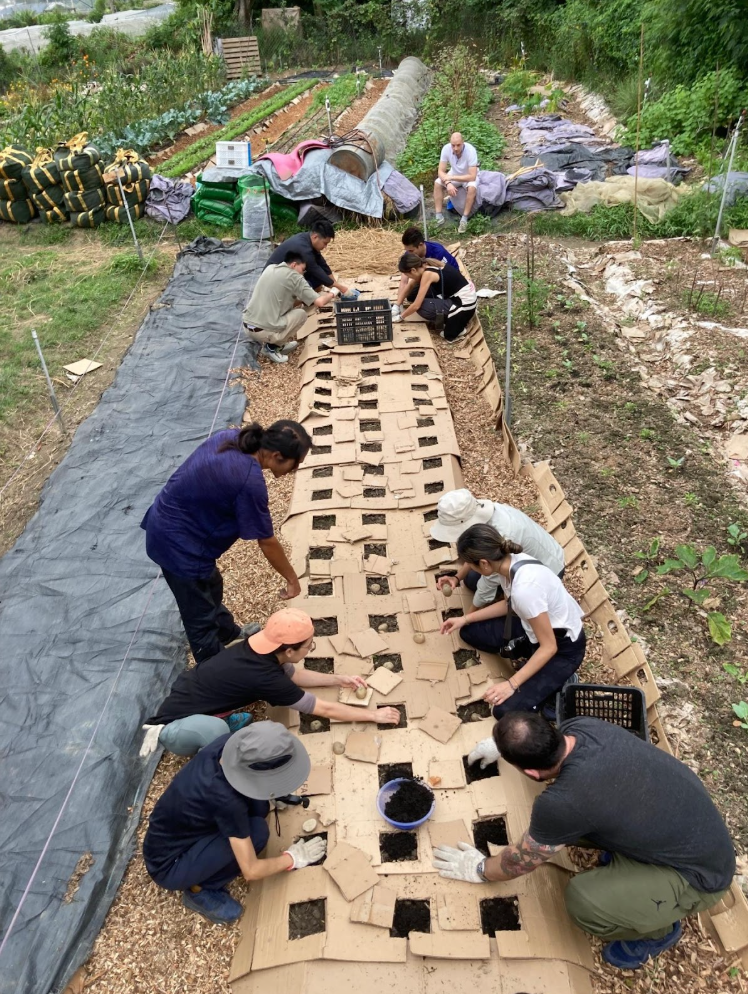
Soil Trust changed the way in which the participants saw nature and turned it from a human-centred view to a much more complex and appreciative frame of mind. The project took up the mandate for invigorating soil habitat through farming activities, composting, and a network between farmers and hospitality industry. Through these activities, it created a model for rebuilding soil and capturing carbon (Figure 1). Its scale was small, but it proved that it is possible to build a positive relationship to animals and plants that is not based on human dominance under the guise of efficiency and validation.
The project built a knowledge alliance that helped to enrich this frame of mind. It relied on a combination of farmer-to-farmer soil testing methods (Singer et al. 2019), citizen science, and external assessment standards to account for carbon restoration, keep track of weather extremes, pest infestations, and soil regeneration to be encapsulated in an open-source practitioner handbook. It also engaged bio-scientists from a local university to conduct soil microbial monitoring, which, despite their best intentions, exceeded the available agronomic and computational expertise and only yielded inconclusive results.
The project, however, was vulnerable to human dominance and ‘development’ that made the change in the community vulnerable to human-led processes in two forms. First, when the initial direct waste-to-soil application came with a lot of mechanical disruption for the fragile topsoil and the farm team decided to add an extra six-month-long composting stage to the processing, the corporate sponsors deemed the operation inefficient and withdrew their funding. Second, Soil Trust was located in the ‘vegetable belt’ of Hong Kong’s New Territories. This belt has a highly fragmented and complicated land tenure, thus our host farmer leases his land from five different landlords on 2-year terms. When the owner of Soil Trust’s plot changed from a villager to an urban developer, the farmland was converted into a ‘brownfield,’ forcing the premature end of the pilot. Here imposed property rights prioritized industrial uses above soil life proliferation. In response, Soil Trust shifted its tactic to sustain its novel frame of mind. It is currently working with media organizations, schools, advocacy groups, policy influencers, and academic publications on social knowledge exchange to promote the adaptation of its model to other contexts and sites.
Finally, the Trust pooled carbon and enacted a place-based strategy that, in principle, any community can engage in without the need for complex technologies that come with hidden costs. The inclusion of diverse perspectives along the process, especially the conflicting ones, have provided a requisite variety that triggered joy, knowledge, creativity, social diversification, and a transformative relationship to nonhumans among the participants of Soil Trust.
Transitioning to regenerative agriculture practices and proliferating land-based biodiversity typically takes years or decades of experimentation to show tangible results. Thus, Soil Trust is part of an extended soil-to-soil strategy that researchers started before and continues beyond the pilot. By focussing on bringing living biodiversity into the soil with pre-existing local resources, the pilot has been navigating human dominion in relation to nonhuman interdependency. It has shaped responses, subjectivities, and a co-emergence with living eco-social habitats, which have become the ultimate measure of value. Thinking of humans as guardians of nonhuman wards thus begs the question how we can change course to a model of continued investment whereby inputs outpace the outputs to generate abundance and benefits for all.
Figure: Soil life guardianship at the Soil Trust eco-social pilot applied regenerative principles including (1) no-till, (2) permanent soil cover and (3) polyculture of crops: here hoteliers collaborating on Soil Trust’s food scrap upcycling program are invited to a communal potato planting using a sheet-mulch technique with cardboards to protect soil live from UV and other disturbance.
REFERENCES:
Bardzell Jeffrey, Bardzell Shaowen and Light Ann (2021). Wanting To Live Here: Design After Anthropocentric Functionalism. CHI ‘21: Proceedings of the 2021 CHI Conference on Human Factors in Computing Systems, Article No. 293:1–24, https://doi.org/10.1145/3411764.3445167
Bar-On, Yinon M., Phillips, Ron and Milo, Ron (2018). The biomass distribution on Earth. Proceedings of the National Academy of Sciences (PNAS), 115(25):6506-6511.
https://doi.org/10.1073/pnas.1711842115
Burgess Rebecca and White Courtney (2021). Fibreshed: Growing a Movement of Farmers, Fashion Activists, and Makers for a New Textile Economy. White River Junction, Vermont:
Chelsea Green Publishing.
Clarke Rachel, Heitlinger Sara, Foth Marcus, DiSalvo Carl, Light Ann, Forlano Laura (2018). More-than-human urban futures: speculative participatory design to avoid ecocidal smart cities, PDC ‘18: Proceedings of the 15th Participatory Design Conference: Short Papers, Situated Actions, Workshops and Tutorial, 2 August, Article No.: 34: 1–4. https://doi.org/10.1145/3210604.3210641
Desmond Hugh and Ramsey Grant (2023). Human Success: Evolutionary Origins and Ethical Implications. Oxford: Oxford University Press.
Desmond Hugh (2024, May 27). Human Dominance is a Fact Not a Debate. Aeon Magazine. Available at: https://aeon.co/essays/human-dominance-is-a-fact-not-a-debate
Orrù, Anna Maria (2018). Body Weathering – Choreography By Space. RUUKU: Studies in Artistic Research, 10 (Special Issue: Catalyses), Available at:
https://www.researchcatalogue.net/view/453323/453324
St. Pierre, Louise (2019). Design and Nature: A History. In: Design and Nature: A Partnership (Fletcher Kate, St. Pierre Louise and Tham Mathilda, eds.). London: Routledge (93-108).
Secomandi, Fernando (2022). Book Review—Things We Could Design: For More Than Human-Centered Worlds. Design Studies, 80:C. https://doi.org/10.1016/j.destud.2022.101098
Singer Brooke, Perl Egendorf, Sara, Flores, Katharhy and Prefer, Marisa (2019). Carbon Sponge: A guide to grow carbon in urban soils (and beyond). New York: White Feather Farm.
Tironi Martin, Chilet Marcos, Martín Carola Ureta, and Hermansen Pablo (2024). Design For More-Than-Human Futures: Towards Post-Anthropocentric Worlding. London: Routledge.
Weyler, Rex (2018). How much of Earth’s biomass is affected by humans? Greenpeace. Available at: https://www.greenpeace.org/international/story/17788/how-much-of-earths-biomass-is-affected-by-humans/
Wakkary, Ron (2021). Things We Could Design: For More Than Human-Centered Worlds. Cambridge, Massachusetts: MIT Press, 2021.
Wernli Markus, Chan Kam Fai (2023). Provocation Soil Trust: Designing economies inside an interspecies world of feeders. Journal of Cultural Economy, 16(4):594–603. https://doi.org/10.1080/17530350.2023.2239823